


ISRO Scientists Leaving
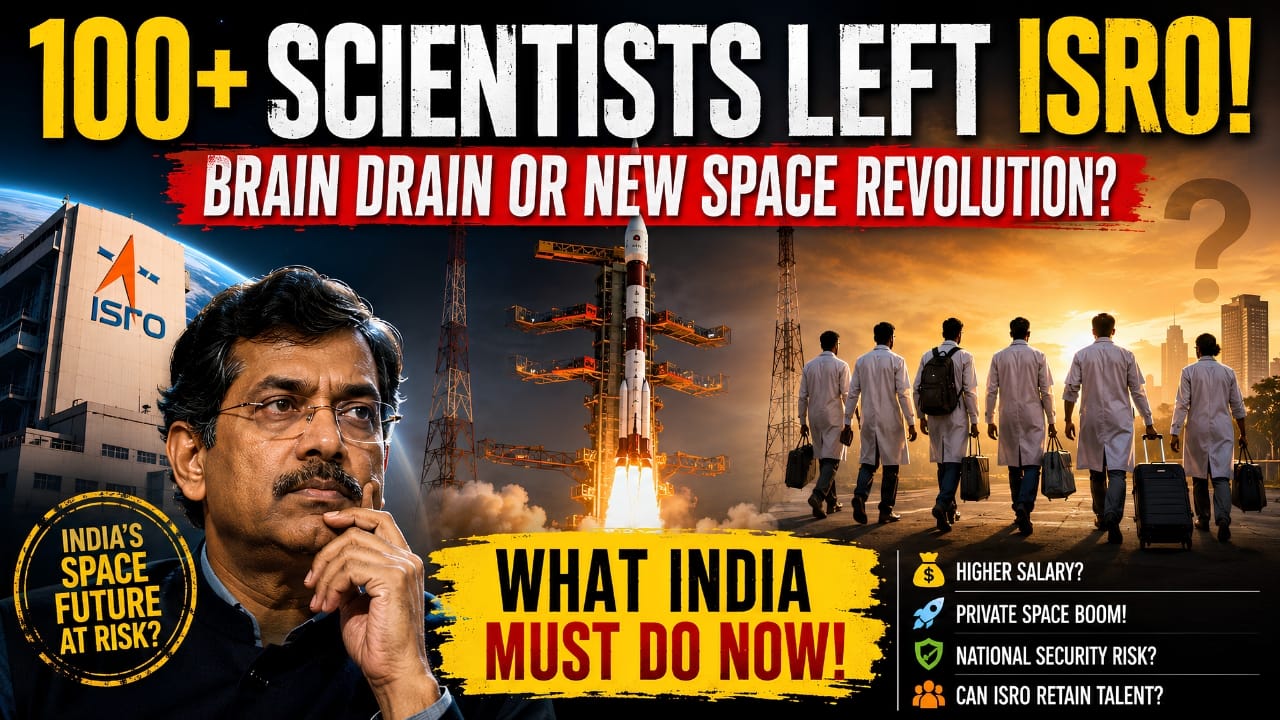
ISRO Scientists Leaving: A National Concern or a Natural Evolution?
The Indian Space Research Organisation (ISRO) is not just another government institution. It is one of the strongest symbols of India's scientific excellence and technological self-reliance. Every successful satellite launch, every lunar mission, and every Mars exploration has strengthened India's position as a respected space power.
Over the past two decades, ISRO has amazed the world with missions that combined world-class engineering with remarkable cost efficiency. Whether it was Chandrayaan, Mangalyaan, Aditya-L1, or the upcoming Gaganyaan mission, ISRO has consistently demonstrated that innovation is not limited by budget.
However, recent reports suggesting that more than 100 scientists and engineers have resigned from ISRO in a short period have triggered widespread discussion across India. Many of these professionals were reportedly associated with some of India's most ambitious space projects.
This development has raised several important questions.
Is India witnessing a serious brain drain?
Are private space companies attracting ISRO's best talent?
Could this affect India's future missions?
Or is this simply the natural evolution of India's growing space economy?
The answers are not as simple as they appear. To understand the present situation, we must first understand how ISRO became one of the world's most respected space agencies.
The Birth of India's Space Programme
India's journey into space began long before rockets started reaching the Moon.
In the early 1960s, India was still a developing nation struggling with poverty, food shortages, and limited industrial infrastructure. Despite these challenges, visionary scientist Dr. Vikram Sarabhai believed that space technology could transform India's future.
Unlike many countries that viewed space exploration primarily as a military competition, Sarabhai imagined satellites helping ordinary citizens through:
Weather forecasting
Disaster management
Agricultural planning
Communication services
Education
National development
His vision was clear.
India did not need space technology to compete with superpowers. India needed space technology to improve the lives of its people.
This philosophy continues to define ISRO even today.
INCOSPAR: The Beginning of India's Space Dream
India's first organized effort in space research began in 1962 with the establishment of the Indian National Committee for Space Research (INCOSPAR).
The committee operated under the Department of Atomic Energy and was led by Dr. Vikram Sarabhai.
Its initial responsibilities included:
Studying rocket technology
Identifying launch locations
Building scientific capabilities
Developing India's indigenous space programme
One of the committee's first major decisions was selecting Thumba in Kerala as India's rocket launching site.
Because Thumba lies close to the Earth's magnetic equator, it offered ideal conditions for atmospheric and space research.
India's First Rocket Launch
The early days of India's space programme are now legendary.
Instead of sophisticated transportation systems, scientists often carried rocket components on bicycles and bullock carts.
These images have become symbols of India's determination.
In 1963, India successfully launched its first sounding rocket from Thumba.
Although modest compared to today's launches, this event marked the beginning of a remarkable scientific journey.
Formation of ISRO
As India's ambitions grew, the government realized that a dedicated space organization was necessary.
On 15 August 1969, the Indian Space Research Organisation (ISRO) was officially established.
Its primary objectives included:
Developing indigenous satellite technology
Building launch vehicles
Advancing scientific research
Strengthening national communication
Supporting weather forecasting
Promoting peaceful use of outer space
This marked the beginning of an institution that would later become one of the world's most respected space agencies.
The Department of Space
Managing a rapidly growing scientific organization required a dedicated administrative framework.
Therefore, in 1972, the Government of India established the Department of Space (DoS).
The Department reports directly to the Prime Minister of India and oversees the country's space activities.
This administrative structure allowed scientists to focus primarily on research while the government handled policy, funding, and organizational management.
How ISRO Became a Network of Specialized Centres
Many people imagine ISRO as a single institution.
In reality, it functions as a vast network of highly specialized research centres across India.
Each centre focuses on a specific area of space technology.
For example:
Vikram Sarabhai Space Centre (VSSC)
Responsible for:
Rocket design
Launch vehicle development
Propulsion systems
U R Rao Satellite Centre (URSC)
Specializes in:
Satellite design
Satellite manufacturing
Satellite integration
Liquid Propulsion Systems Centre (LPSC)
Works on:
Cryogenic engines
Liquid propulsion technologies
Advanced engine development
Space Applications Centre (SAC)
Develops technologies related to:
Communication
Remote sensing
Navigation
Earth observation
Satish Dhawan Space Centre (SDSC SHAR)
India's primary launch facility responsible for:
Rocket launches
Launch infrastructure
Mission operations
This decentralized structure allows ISRO to manage extremely complex missions involving thousands of scientists working across multiple disciplines.
ISRO's Extraordinary Achievements
Over the past five decades, ISRO has achieved milestones that many developed nations admire.
PSLV: The Reliable Workhorse
The Polar Satellite Launch Vehicle (PSLV) became one of the world's most reliable launch systems.
It has successfully launched:
Indian satellites
Foreign satellites
Scientific missions
Commercial payloads
Its reliability made India a preferred destination for satellite launches.
GSLV and LVM3
The Geosynchronous Satellite Launch Vehicle (GSLV) and its advanced versions enabled India to launch heavier satellites into space.
The LVM3 (formerly GSLV Mk III) has become India's most powerful operational launch vehicle and is expected to play a major role in future human space missions.
Chandrayaan Programme
India stunned the world with its lunar missions.
Chandrayaan-1
Confirmed the presence of water molecules on the Moon.
Significantly changed global understanding of lunar science.
Chandrayaan-2
Although the lander faced challenges during landing, the orbiter continues to generate valuable scientific data.
Chandrayaan-3
India achieved a historic milestone by successfully landing near the Moon's south pole.
This made India the first country to accomplish such a feat and only the fourth nation to achieve a soft landing on the Moon.
Mangalyaan
India's Mars Orbiter Mission (Mangalyaan) became one of the greatest achievements in global space history.
It successfully entered Mars' orbit on its very first attempt.
Even more remarkable was its cost efficiency.
The mission demonstrated that innovation and careful engineering can sometimes achieve more than massive budgets.
Aditya-L1
India also expanded its ambitions toward solar exploration.
Aditya-L1 was launched to study the Sun's atmosphere, solar winds, and space weather.
The mission is expected to improve scientific understanding while helping protect communication and navigation systems affected by solar activity.
Gaganyaan
India is now preparing for one of its biggest milestones.
The Gaganyaan programme aims to send Indian astronauts into space aboard an indigenous spacecraft.
If successful, India will join a select group of nations capable of independently conducting human spaceflight missions.
Why ISRO Matters Beyond Space Exploration
Many people assume space missions are only about scientific prestige.
In reality, satellites affect everyday life.
ISRO's technologies support:
Weather forecasting
GPS and navigation
Mobile communication
Television broadcasting
Internet connectivity
Disaster warning systems
Agriculture monitoring
Fisheries
Environmental protection
National security
Every time someone checks navigation on a smartphone, watches satellite television, receives cyclone warnings, or uses satellite-based communication, space technology plays a silent but critical role.
That is why ISRO's success impacts every Indian, even those who may never directly think about space exploration.
Why the Recent Scientist Resignations Have Drawn Attention
Against this remarkable backdrop, reports of more than 100 scientists and engineers leaving ISRO naturally attracted national attention.
While ISRO employs thousands of professionals, concerns arise when experienced scientists associated with strategic projects decide to move elsewhere.
The questions become even more significant because India is entering an ambitious phase of space exploration involving:
Human spaceflight
Advanced lunar missions
Space station planning
Deep-space exploration
Expanding commercial launch services
At such a crucial stage, retaining experienced scientific talent becomes increasingly important.
However, the story is more complex than simple resignations.
India's space sector itself has changed dramatically over the last few years.
Hundreds of private space companies have emerged, creating exciting new opportunities for scientists and engineers.
Does this represent a dangerous brain drain—or the birth of a vibrant Indian space industry?
India's Space Sector Has Entered a New Era
For decades, India's space ecosystem revolved almost entirely around one organization—ISRO.
If someone wanted to build rockets, satellites, propulsion systems, or space communication technology, ISRO was practically the only destination. It served as the country's sole engine of innovation in the space sector.
That landscape has changed dramatically.
Since 2020, India has opened its space sector to private participation, encouraging startups, entrepreneurs, investors, and global collaborations. What was once a government-dominated industry has evolved into a rapidly growing commercial ecosystem.
This transformation has created tremendous opportunities—but it has also introduced new challenges, including the movement of experienced scientists from ISRO to private companies.
From Government Monopoly to a Competitive Ecosystem
For nearly five decades, ISRO enjoyed a unique position.
It was responsible for almost every major aspect of India's space programme:
Rocket development
Satellite manufacturing
Launch services
Space research
International collaborations
Commercial satellite launches
Young engineers graduating from institutions like IITs, IISc, and leading engineering colleges had one dream—to work at ISRO.
Competition was intense, but the career path was relatively straightforward.
Today, the situation is completely different.
Instead of one employer, talented scientists now have hundreds of career options.
Why Did India Open the Space Sector?
The answer lies in a simple reality.
The global space economy is expanding rapidly.
Governments around the world realized that they alone cannot drive innovation at the required speed. Private companies bring agility, investment, entrepreneurial thinking, and faster execution.
Countries like the United States demonstrated this model successfully.
NASA gradually shifted many commercial launch responsibilities to private companies while focusing on advanced scientific exploration and deep-space missions.
Companies such as SpaceX and Blue Origin transformed the commercial launch market and significantly reduced launch costs.
India observed this global shift and recognized that a similar approach could unlock enormous economic opportunities.
The Space Sector Reforms of 2020
In 2020, the Government of India introduced one of the most significant policy reforms in the country's space history.
The reforms aimed to encourage private participation in:
Satellite manufacturing
Rocket development
Launch services
Space applications
Earth observation
Space technology innovation
The objective was not to replace ISRO.
Instead, the goal was to build an ecosystem where government institutions and private companies could grow together.
This policy opened the doors for hundreds of startups that previously had limited access to India's space infrastructure.
The Creation of IN-SPACe
Opening the space sector required proper regulation.
The government therefore established the Indian National Space Promotion and Authorization Centre (IN-SPACe).
Its responsibilities include:
Authorizing private space activities
Regulating commercial participation
Ensuring safety and compliance
Providing access to ISRO facilities
Encouraging innovation while protecting national interests
IN-SPACe acts as a bridge between ISRO and private companies, ensuring that commercial participation strengthens rather than weakens India's space programme.
The Role of NSIL
Another important institution created during these reforms is New Space India Limited (NSIL).
Its primary responsibility is commercialization.
NSIL helps convert ISRO's technological capabilities into commercial opportunities by:
Marketing launch services
Commercializing space technologies
Managing satellite launches for customers
Building partnerships with industry
Rather than allowing ISRO to handle both research and business development, NSIL focuses on the commercial side while ISRO continues concentrating on scientific advancement.
India's Space Startup Revolution
The results of these reforms have been extraordinary.
Within just a few years, India witnessed the emergence of hundreds of space technology startups.
Today, the country has one of the fastest-growing private space ecosystems in the world.
Many of these startups specialize in:
Small satellite launches
Satellite imaging
Space data analytics
Rocket engines
Orbital transportation
Space communication
Defence applications
This rapid expansion has generated thousands of high-skilled jobs.
But it has also intensified competition for experienced talent.
The New Stars of India's Space Industry
Several startups have emerged as major players in India's commercial space sector.
Skyroot Aerospace
Skyroot Aerospace became the first Indian private company to successfully launch a privately developed rocket.
Its Vikram rocket series demonstrated that Indian startups could build advanced launch systems capable of competing internationally.
The company's rapid growth has attracted experienced aerospace professionals from across the country.
Agnikul Cosmos
Agnikul Cosmos has gained international attention for its innovative rocket engine technologies, including advanced 3D-printed engines.
The company focuses on launching small satellites and aims to make access to space more affordable and flexible.
Its engineering-driven culture appeals strongly to experienced scientists looking for cutting-edge research opportunities.
Pixxel
Pixxel specializes in satellite imaging and Earth observation.
Its hyperspectral satellites collect highly detailed data that can be used in:
Agriculture
Environmental monitoring
Mining
Climate research
Urban planning
Disaster management
The company represents a different side of the space economy—using satellites not only for launching into space but also for solving real-world problems on Earth.
Dhruva Space
Dhruva Space develops satellite platforms, mission support services, and integrated space solutions.
Rather than focusing solely on rockets, the company works across multiple segments of the space value chain.
Digantara
Digantara focuses on space situational awareness.
As Earth's orbit becomes increasingly crowded with satellites and space debris, tracking objects accurately has become a critical global requirement.
Companies like Digantara are building technologies to address this growing challenge.
Why Investors Are Excited
Private space companies are attracting enormous investment.
Global investors recognize that the future space economy extends far beyond government missions.
Commercial opportunities include:
Satellite internet
Climate monitoring
Defence technology
Precision agriculture
Autonomous transportation
Navigation systems
Telecommunications
Data analytics
As a result, Indian startups have collectively raised hundreds of millions of dollars in funding over the past few years.
This influx of capital enables companies to hire aggressively, invest in research, and compete for top engineering talent.
Where Will These Companies Find Experienced Scientists?
This is where the current debate begins.
Building rockets is not like launching a software startup.
A rocket engineer cannot be trained in six months.
Space scientists often spend decades developing expertise in:
Propulsion systems
Orbital mechanics
Satellite integration
Cryogenic engines
Navigation
Mission planning
Systems engineering
When hundreds of private companies suddenly enter the market, they require experienced professionals immediately.
Naturally, they begin recruiting from organizations that already possess this expertise.
The largest talent pool exists within ISRO.
Why Are ISRO Scientists Moving?
The reasons vary from person to person, but several common factors explain this transition.
1. Better Compensation
Private companies generally have greater flexibility in offering:
Higher salaries
Performance bonuses
Stock options
Equity ownership
Long-term wealth creation
For highly specialized scientists, these incentives can be extremely attractive.
2. Faster Career Growth
Government organizations often follow structured promotion systems.
Career progression may depend on:
Seniority
Administrative processes
Organizational hierarchy
Private companies usually reward performance more quickly.
Scientists who demonstrate exceptional capabilities may receive leadership roles much earlier.
3. Entrepreneurial Freedom
Many scientists want to build new technologies rather than work within established structures.
Private companies often provide:
Greater autonomy
Faster decision-making
Smaller, agile teams
Freedom to experiment
For researchers with entrepreneurial ambitions, startups can be highly appealing.
4. Cutting-Edge Innovation
Many startups focus on emerging technologies that are still evolving globally.
These include:
Reusable launch vehicles
Small satellite launch systems
Space manufacturing
Advanced propulsion
AI-powered satellite operations
Scientists interested in pioneering new technologies may view startups as exciting career opportunities.
Is This Really Brain Drain?
The phrase "brain drain" usually describes talented professionals leaving one country for another.
But in this case, many scientists are not leaving India.
They are simply moving from a government organization to Indian private companies.
This distinction is important.
If an ISRO scientist joins an Indian startup that continues building rockets within India, the expertise remains inside the country.
The national knowledge base is not necessarily lost.
However, the transition still creates short-term challenges for ISRO, especially when experienced personnel leave during critical missions.
The Challenge of Timing
Every major space mission depends heavily on experienced leadership.
Projects such as:
Gaganyaan
Chandrayaan
Advanced launch vehicles
Deep-space missions
require years of planning.
When senior scientists leave midway through complex projects, organizations must:
Transfer technical knowledge
Train replacements
Maintain continuity
Avoid delays
Even if successors are highly capable, replacing decades of experience is never easy.
This is why recent resignations have attracted national attention.
Competition Can Also Strengthen ISRO
Although talent movement creates challenges, competition also produces positive outcomes.
Healthy competition encourages organizations to improve.
ISRO may eventually benefit through:
Better salaries
Improved working conditions
Faster promotions
Increased research funding
Modern management practices
Stronger collaboration with industry
In many sectors, competition has accelerated innovation rather than weakening established institutions.
The same could happen in India's space programme.
A Delicate Balance
India now stands at an important crossroads.
On one side lies the need to protect ISRO's invaluable institutional knowledge.
On the other lies the opportunity to build a thriving commercial space economy capable of creating thousands of high-skilled jobs and positioning India as a global leader in space technology.
The challenge is not choosing one over the other.
The real challenge is ensuring that both government institutions and private companies grow together in a way that strengthens India's long-term strategic interests.
Beyond Resignations: Why This Debate Matters
The resignation of experienced scientists from ISRO is not merely an employment issue. It touches several critical areas that directly impact India's future:
National security
Technological leadership
Scientific innovation
Talent retention
Global competitiveness
Economic growth
While many experts believe that scientists moving to Indian private companies is a natural consequence of a growing space economy, others warn that India must proceed carefully.
The challenge is not just losing employees.
The challenge is protecting decades of accumulated scientific knowledge while continuing to encourage innovation.
Can Experience Be Replaced Overnight?
Every successful space mission depends on years of accumulated expertise.
A senior scientist working on:
Rocket propulsion
Guidance systems
Satellite integration
Mission planning
Cryogenic technology
is not simply performing a job.
Such professionals carry decades of practical experience that often cannot be documented completely in manuals or technical reports.
Many engineering decisions are based on lessons learned through years of testing, failures, and successful launches.
When these experienced individuals leave, replacing them is far more difficult than filling a vacant position.
Knowledge transfer takes time.
That is why the departure of senior scientists naturally raises concerns.
The National Security Dimension
India's space programme is deeply connected to national security.
Many technologies developed for civilian purposes also have strategic importance.
Examples include:
Satellite communication
Navigation systems
Earth observation
Missile-related technologies
Remote sensing
Defence surveillance
For this reason, governments across the world closely monitor the movement of scientists working in sensitive sectors.
Although there is no evidence that recent resignations involve wrongdoing, policymakers must remain alert to potential risks.
Technology Is the New Strategic Asset
Modern conflicts are no longer fought only with conventional weapons.
Technological superiority increasingly determines national strength.
Countries compete intensely in areas such as:
Artificial Intelligence
Quantum Computing
Semiconductor manufacturing
Space technology
Cybersecurity
Satellite communications
In this environment, highly skilled scientists become strategic national assets.
Retaining talent is therefore not only an economic issue but also a matter of long-term national capability.
Could Foreign Interests Exploit the Situation?
Whenever experienced scientists move between organizations, questions naturally arise about intellectual property and sensitive knowledge.
Suppose a foreign investor indirectly funds a private company.
Suppose that company aggressively recruits experienced scientists from strategic government organizations.
Even if all legal procedures are followed, governments must ensure that:
Sensitive technologies remain protected.
National security protocols are maintained.
Strategic research does not unintentionally leak outside authorized channels.
Most advanced countries maintain strict regulations governing such transitions.
India will likely need to continue strengthening similar safeguards as its private space industry grows.
Lessons from the Nambi Narayanan Case
India's space history has already witnessed painful controversies.
One of the most well-known examples is the case of Nambi Narayanan, a senior ISRO scientist who was falsely accused in the 1990s of espionage.
Years later, investigations concluded that the allegations were baseless, and the Supreme Court recognized the injustice he had suffered.
The case highlighted two important realities:
Scientists working in strategic sectors can become vulnerable to serious allegations.
National security issues surrounding space technology require careful, evidence-based handling.
The incident also demonstrated how damaging such controversies can be for scientific institutions and individual researchers alike.
Talent Poaching: A Global Reality
Competition for highly skilled professionals exists in every advanced industry.
Technology companies recruit from competitors.
Hospitals recruit experienced doctors.
Universities recruit leading researchers.
The space industry is no different.
Private companies naturally seek experienced scientists because they reduce development time and improve project success.
This practice is commonly known as talent poaching.
While it is generally legal, excessive talent migration from one institution can create operational challenges.
The Salary Gap
Perhaps the most frequently discussed issue is compensation.
Developing advanced space technologies requires years of education, specialized training, and continuous research.
Yet government salary structures often differ significantly from those offered by private industry.
Private companies can provide:
Higher fixed salaries
Performance bonuses
Stock ownership
Profit-sharing
Faster financial growth
Government organizations, on the other hand, generally operate within standardized pay structures designed for public administration.
This creates a widening compensation gap.
Why Salary Matters
Many people assume scientists work only for passion.
Passion certainly plays an important role.
However, scientists also have families, financial responsibilities, and long-term career aspirations.
Competitive compensation helps:
Attract top students.
Retain experienced researchers.
Encourage innovation.
Reduce unnecessary turnover.
Countries that invest heavily in science generally understand that world-class research requires world-class incentives.
The Global Competition for Scientists
Today's scientific workforce operates in a global marketplace.
Talented researchers receive opportunities from universities, research laboratories, startups, multinational corporations, and government agencies across the world.
Countries such as:
United States
China
Germany
France
United Kingdom
actively invest in attracting global scientific talent.
They often provide:
Advanced laboratories
Large research grants
International collaborations
Attractive salaries
Better research infrastructure
This intense global competition makes talent retention increasingly challenging for every country, including India.
Research Funding Matters as Much as Salary
Compensation is only one part of the equation.
Researchers also value:
Modern laboratories
High-quality equipment
Access to international collaborations
Freedom to pursue innovative ideas
Stable long-term funding
A scientist working with outdated infrastructure may eventually seek opportunities where cutting-edge research is easier to conduct.
Investment in research ecosystems is therefore just as important as investment in salaries.
The "BSNL Comparison"
Some commentators have compared ISRO's situation with that of BSNL.
The comparison suggests that excessive dependence on government systems could eventually reduce competitiveness if private companies advance much faster.
However, this comparison deserves careful examination.
Unlike telecommunications, space exploration involves:
National security
Scientific research
Strategic infrastructure
International diplomacy
ISRO is not merely a commercial service provider.
It performs responsibilities that private companies alone cannot replace.
These include:
Deep-space exploration
Planetary science
Strategic missions
National space policy
Advanced scientific research
Therefore, while commercial competition will grow, ISRO's strategic importance remains unique.
Government vs Private Sector: Not a Zero-Sum Game
A common misconception is that every scientist joining a startup weakens ISRO.
Reality is more nuanced.
Many advanced economies operate through collaboration.
Government agencies develop foundational technologies.
Private companies commercialize them.
Universities produce new researchers.
Industry creates products and services.
Together, they strengthen the national innovation ecosystem.
India can follow a similar collaborative model.
What Can India Learn from NASA?
NASA provides an excellent example.
Over the past two decades, NASA has increasingly partnered with private companies instead of performing every task internally.
Companies such as:
SpaceX
Blue Origin
Northrop Grumman
Boeing
now perform many commercial launch and transportation activities.
Meanwhile, NASA focuses more on:
Deep-space exploration
Mars missions
Scientific discovery
Advanced research
Rather than competing against each other, government and industry increasingly complement one another.
India could continue developing a similar partnership between ISRO and private enterprises.
Building a Sustainable Talent Pipeline
Long-term success requires more than retaining existing scientists.
India must continuously produce new generations of researchers.
This means strengthening:
IITs
IISc
NITs
Space engineering programmes
Aerospace research centres
Doctoral research
University-industry collaboration
A growing talent pipeline ensures that both ISRO and private companies have access to highly qualified professionals.
Policy Measures That Could Strengthen India's Space Ecosystem
Experts often recommend several long-term reforms:
1. Increase Investment in Research and Development
India has significantly expanded its space ambitions.
Future missions will require correspondingly higher investment in research infrastructure.
2. Modernize Compensation Structures
Highly specialized scientists should receive compensation that reflects their strategic importance and global demand.
3. Encourage Industry Collaboration
Rather than viewing private companies as competitors, structured collaboration can accelerate innovation.
Joint research projects can benefit both sectors.
4. Strengthen Knowledge Transfer
When senior scientists retire or change organizations, systematic documentation and mentoring programmes can preserve institutional knowledge.
5. Expand Higher Education Capacity
Producing larger numbers of aerospace engineers and space scientists will reduce future talent shortages.
6. Support Long-Term Research
Breakthrough technologies often require years of experimentation before producing commercial results.
Stable funding encourages ambitious scientific work.
The Bigger Picture
India is no longer merely participating in the global space race.
It is becoming one of its major players.
The country has demonstrated that it can:
Launch satellites efficiently.
Explore the Moon.
Reach Mars.
Study the Sun.
Develop indigenous launch vehicles.
Build globally competitive space startups.
The next challenge is ensuring that this rapid growth remains sustainable.
Success will depend not only on rockets and satellites but also on India's ability to nurture, retain, and continuously develop world-class scientific talent.
Conclusion
The recent movement of scientists from ISRO to private companies should not automatically be viewed as either a crisis or a triumph.
It is a sign that India's space ecosystem is evolving.
Private companies are creating exciting opportunities.
ISRO continues to lead strategic national missions.
Universities are producing new talent.
The government's role is to ensure that these three pillars—public institutions, private industry, and academia—work together rather than compete destructively.
If India succeeds in creating that balance, the country will not merely retain its scientific talent—it will become one of the world's leading space innovation hubs.
With missions such as Gaganyaan, future Chandrayaan expeditions, commercial satellite launches, reusable rockets, and an expanding private space economy, India stands at the threshold of a historic new era. The challenge now is to transform today's talent movement into tomorrow's national strength.

Press Release on Our All Websites for Powerful Online Presence
Get your brand featured with a world-class press release, published across all our high-authority websites — complete with powerful do-follow backlinks. Crafted to meet global press release standards, our service ensures maximum credibility, visibility, and SEO impact. Special pricing and exclusive offers are available for a limited time. Contact us today at sunil@justbaazaar.com to elevate your brand’s presence."
ABOUT US
JB Daily News Since 2018


Created with ©systeme.io