


Kerala Renamed Keralam After Union Cabinet Approval
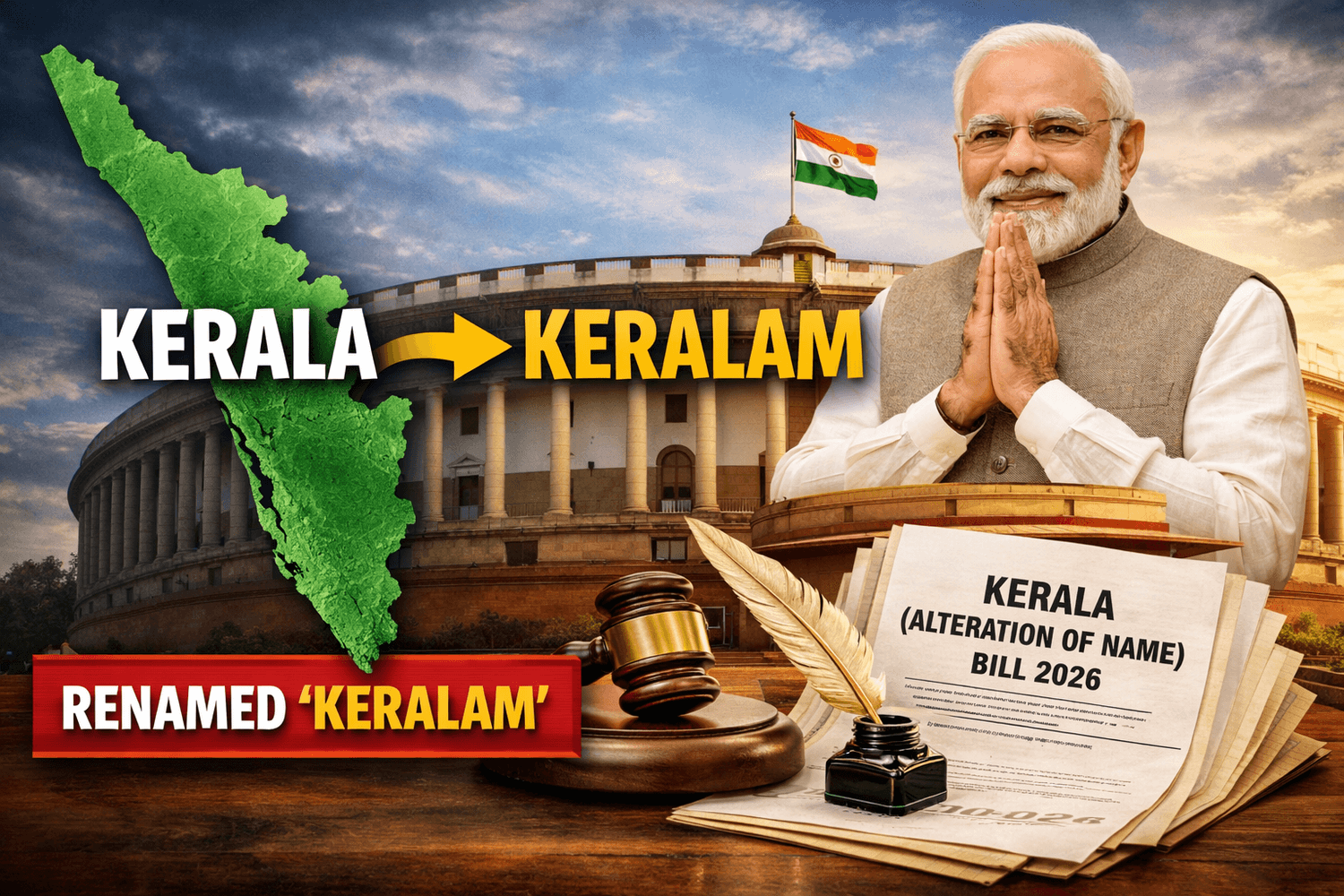
New Delhi — February 24, 2026: In a landmark move that blends cultural heritage, constitutional procedure and electoral politics, the Union Cabinet of India today approved the proposal to rename the southern state of Kerala as “Keralam.” The decision, taken under the chairmanship of Prime Minister Narendra Modi, sets in motion the formal constitutional process that could officially change the state’s name across all legal, administrative and parliamentary frameworks.
The announcement represents one of the most significant administrative renaming decisions in recent years, reviving a long-standing demand by Kerala’s state leadership and linguistic scholars to align the official nomenclature with the state’s Malayalam identity. It also arrives at a politically charged moment—just months ahead of the Kerala Legislative Assembly elections expected later this year.
This in-depth report examines the genesis of the name-change demand, the constitutional mechanics, political and cultural implications, public reactions, comparisons with similar decisions around India, and what lies ahead for the process to be legally completed.
Tracing the Origins: Why “Keralam”?
The proposal to alter Kerala’s official name has deep cultural roots. Supporters argue that the name “Keralam” better reflects the region’s linguistic heritage, as it is the word traditionally used in Malayalam, the state’s predominant language. In Malayalam, “Keralam” is widely understood to mean the “land of coconuts”—with the syllable kerasignifying coconut and alam meaning land—evoking both geographic identity and agrarian imagery central to the state’s cultural lexicon.
The demand is not new. As early as August 2023, the Kerala Legislative Assembly unanimously adopted a resolution urging the Central Government to initiate the renaming process by amending the First Schedule of the Constitution of India, where all states and union territories are listed. A second unanimous resolution in June 2024 reaffirmed the demand, after technical adjustments were suggested by the Ministry of Home Affairs to earlier proposals.
Officials in Thiruvananthapuram (Kerala’s state capital) noted that while Kerala was formed along linguistic lines in 1956 following the States Reorganisation Act, its constitutional name has persisted in its Anglicised form. Advocates of the change argued that formal recognition of “Keralam” would correct this colonial-era legacy and align it with the state’s cultural self-perception.
Cabinet Approval and Constitutional Pathway
At its sitting on Tuesday, February 24, 2026, the Union Cabinet approved the proposal to alter the state’s name from Kerala to Keralam. While the decision does not immediately effect the name change, it authorises the government to proceed under Article 3 of the Indian Constitution—the constitutional provision that empowers Parliament to alter a state’s name, area or boundaries.
Information and Broadcasting Minister Ashwini Vaishnaw, briefing the press after the meeting, explained the procedural steps that will now follow:
Presidential Reference: The President of India will refer the Kerala (Alteration of Name) Bill, 2026 to the Kerala Legislative Assembly for its views. This is mandated by the proviso to Article 3, which requires the state legislature to be consulted before Parliament considers legislation involving a change in name.
State Legislative View: The state assembly will express its opinion within a specified timeframe, laying out support—or any objections—before the bill is returned to the Centre.
Parliamentary Passage: Following receipt of the Assembly’s view, the bill will be introduced in Parliament. Parliament’s approval (both Lok Sabha and Rajya Sabha) is essential for the name change to become legally binding.
Presidential Assent: After Parliament passes the bill, the President’s assent will finalise the amendment of the First Schedule, establishing “Keralam” as the constitutional name of the state.
Only after these steps are complete will official documents, gazette notifications, maps and government records reflect the new name.
Political Timing: Name Change Ahead of Polls
The timing of this development cannot be separated from the upcoming Kerala Assembly elections, scheduled to be held in the first half of 2026. Observers across the political spectrum have highlighted that the approval comes at a crucial juncture when political parties are gearing up for intense electoral competition.
Many analysts suggest that central approval of the renaming proposal may resonate culturally with Malayali voters, particularly those who view the issue as affirming linguistic pride and identity. Historically, language has played a formative role in Kerala’s socio-political discourse—evident in the Aikya Kerala Movement, which led to the unification of Malayalam-speaking regions into the modern state in 1956.
Political stakeholders in both national and state parties are actively debating the name change’s electoral impact. Supporters argue that it reinforces respect for local culture, while critics question whether the focus on nomenclature might divert attention from core governance and development issues. Given Kerala’s complex political landscape—often marked by sharp contestation between left, centrist and regional coalitions—the renaming move adds a new dimension to election discourse.
Cultural Significance and Public Reaction
The Cabinet’s decision drew varied responses across media, political circles and public forums:
Cultural Advocates: Many cultural commentators and linguists welcomed the move, portraying it as a long-overdue recognition of Kerala’s indigenous identity. The name “Keralam,” they argue, roots the state firmly within its Malayali linguistic and historical continuum.
Political Reactions: While ruling party leaders in Kerala and national political allies applauded the approval, opposition voices raised questions about the political motivation given its proximity to elections.
Public Debate: A light-hearted ripple spread through social media after former Congress MP Shashi Tharoorhumorously questioned how demonyms like “Keralite” or “Keralamian” might evolve if the state’s name changes—sparking discussions about linguistic ramifications and usage in English.
Amid these discussions, scholars emphasized that renaming is more than semantic; it reaffirms the cultural pride of a region whose literature, art, philosophy and social achievements have long been shaped by Malayalam sensibilities. For many Malayalis at home and abroad, the name “Keralam” carries a deeper resonance than its Anglicised counterpart.
Comparison with Other States
India has witnessed several notable geographical and administrative renaming initiatives over the past decades:
Bombay → Mumbai (1995): Reflecting Marathi linguistic identity.
Madras → Chennai (1996): Aligning with Tamil usage.
Orissa → Odisha (2011): Recognising the state’s Oriya name.
Eighth Schedule Alterations: Several languages were added and recognised constitutionally over time.
These precedents underscore India’s ongoing efforts to decolonise names and bring official nomenclature closer to local pronunciation and heritage. The move to rename Kerala falls squarely within this broader pattern of linguistic affirmation.
Legal and Administrative Implications
Renaming a state is more than a symbolic gesture; it carries significant administrative and legal consequences:
Constitutional Amendment: The First Schedule change requires precise drafting to avoid ambiguity in listings across languages in the Constitution.
Official Records: Government gazettes, legal documents, judicial records and administrative systems will need updating.
International Reference: Maps, official reports, diplomatic correspondence and global references will gradually adopt “Keralam” once the process is complete.
Legal experts note that while the constitutional process is straightforward, efficient execution demands coordination across ministries—Home Affairs, Law and Justice, Parliamentary Affairs—and the President’s Secretariat to ensure no procedural lapses occur.
Voices from Kerala: Public Sentiment
In Kerala, public sentiment is a mix of pride, curiosity and debate:
Malayali Cultural Leaders: Many view the proposal as a recognition of Kerala’s rich history of literature and scholarship, where “Keralam” has always been the traditional appellation.
Urban Youth: On university campuses and social media, students and young citizens have taken to debates on identity, pointing out the linguistic logic while also engaging humorously with the expected changes in how residents will describe themselves.
Political Analysts: They highlight that the name change could become an electoral talking point, emphasising regional pride against a backdrop of intense political competition.
What Comes Next? Parliamentary and State Assembly Steps
Now that the Cabinet has approved the proposal:
State Assembly Consultation: The Kerala (Alteration of Name) Bill, 2026 will be formally referred to the Kerala Legislative Assembly by the President for its opinion under Article 3.
Parliamentary Debate: After state consultation, the bill will be introduced and debated in both houses of Parliament—Lok Sabha and Rajya Sabha.
Presidential Assent & Gazette Notification: Upon parliamentary approval, Presidential assent will legally sanctify “Keralam” as the new name. The change will then be notified in the Official Gazette of India.
Only after these steps will administrative systems and legal documents begin executing the new nomenclature in everyday governance.
Conclusion: Heritage, Identity, Politics and Process
The Union Cabinet’s decision to approve the renaming of Kerala to “Keralam” marks a historic intersection of cultural assertion and constitutional democracy. It celebrates the linguistic pride of a region that has contributed significantly to India’s cultural tapestry, while also underlining the democratic processes that govern territorial nomenclature in the world’s largest republic.
Whether it reshapes political narratives in the upcoming assembly elections or becomes a celebrated point of cultural affirmation, the journey from Kerala to Keralam reflects the evolving dynamics of identity and governance in India (Bharat). The next chapters of this story will be written in the halls of the Kerala Legislative Assembly and the Parliament of India—but the historic spirit of this decision has already taken firm root in contemporary discourse.

Press Release on Our All Websites for Powerful Online Presence
Get your brand featured with a world-class press release, published across all our high-authority websites — complete with powerful do-follow backlinks. Crafted to meet global press release standards, our service ensures maximum credibility, visibility, and SEO impact. Special pricing and exclusive offers are available for a limited time. Contact us today at sunil@justbaazaar.com to elevate your brand’s presence."
ABOUT US
JB Daily News Since 2018


Created with ©systeme.io