


UGC, General Category Anxiety, and the Crisis of Trust: Modi Ji, You Won. Now Solve the Problem at Hand
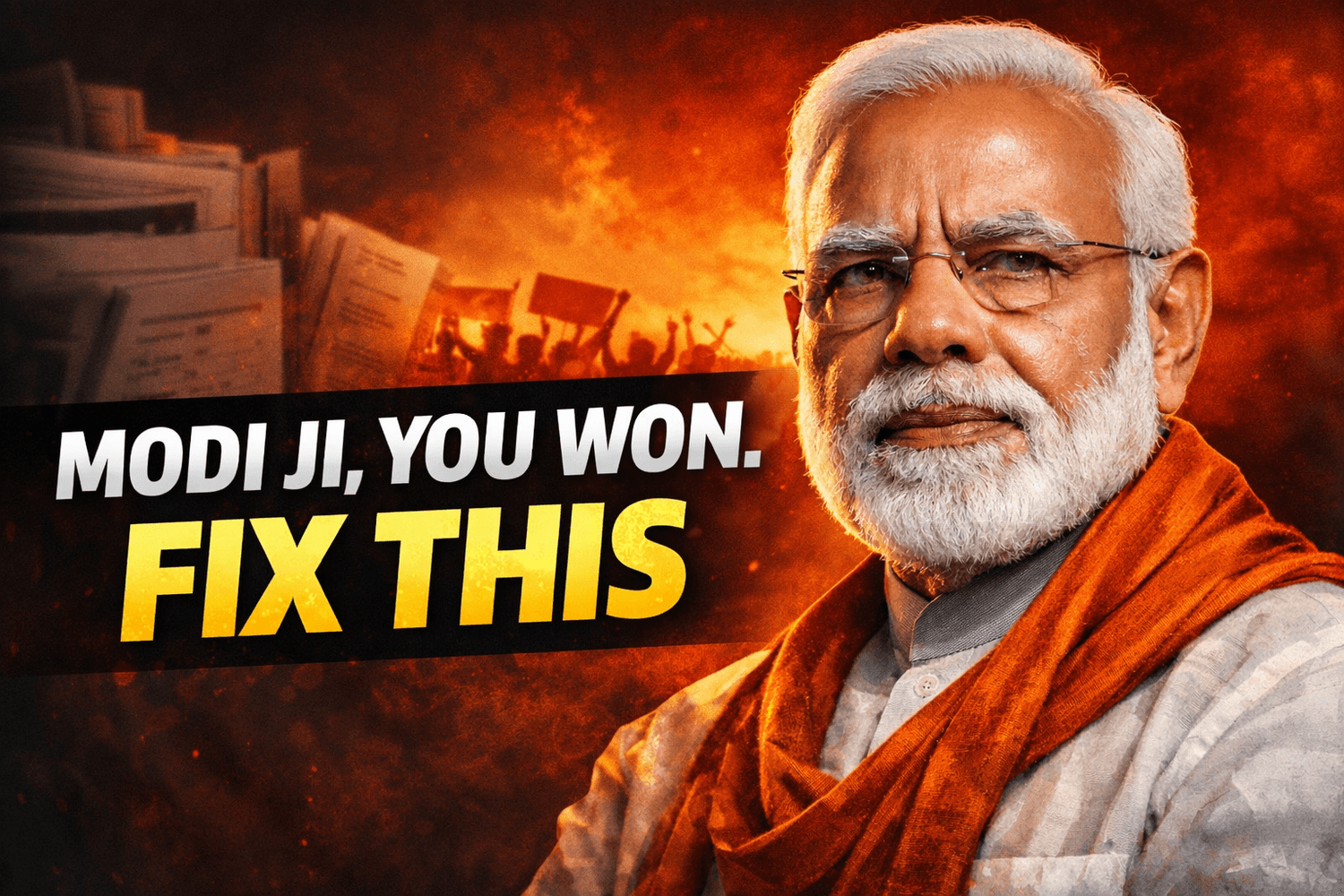
An Analytical Reflection on Governance, Representation, and the Breaking Point of Supporters
#Tandavacharya #ModiPolitics #UGCDebate
In Indian politics, criticism from ideological opponents is expected. It is routine. It is often dismissed. It can even be politically useful. But when criticism begins to emerge from those who once stood firmly in support, who defended a government for years, who believed in its civilizational mission, and who amplified its narrative when it was unpopular or under attack, that criticism deserves serious attention.
That is precisely what this moment represents.
The debate around the recent UGC-related controversy, and the broader anxiety among sections of the general category, especially upper-caste communities, is not merely a policy disagreement. It is not just about academic regulations. It is not even just about reservation or representation in higher education. It is about something deeper: the growing perception among a section of long-time nationalist and BJP-supporting voices that the government is becoming indifferent to their concerns, unresponsive to their warnings, and increasingly insulated from its own ideological base.
This is the central theme of the emotional and politically loaded appeal captured in the video titled “UGC & General Caste Issue: Modi Ji, I Concede. You WON. Now, Solve The Problem At Hand.” The speaker is not presenting himself as an opponent of Prime Minister Narendra Modi. On the contrary, he repeatedly frames himself as someone who has supported Modi, admired Modi, and continues to believe in Modi’s stature as a transformational leader. Yet, the speech is also a blunt admission of frustration, exhaustion, and surrender. It is the rhetoric of a supporter who says: “I cannot fight you. I cannot force you. You are more powerful. So I concede. But now, as the leader you are, solve this problem.”
That is what makes this intervention politically significant.
This Is Not Anti-Modi. It Is Post-Patience
One of the most important elements in the transcript is the speaker’s insistence that his criticism is not born of ideological hostility. He goes out of his way to establish that his opposition to certain ministers, policies, or silences should not be misread as a rejection of Narendra Modi’s larger leadership. In fact, he explicitly acknowledges the scale of the 2014 movement that brought Modi to power.
According to the argument, 2014 was not just a BJP election campaign. It was a much wider civilizational mobilization. It involved not just party workers, but religious leaders, nationalist organizations, cultural influencers, yoga icons, and ideological supporters who believed India had reached a turning point. There was a widespread feeling that the country could finally move away from what they saw as a colonial, deracinated, self-denying political culture and toward a more confident, civilizationally rooted national direction.
In that framing, Modi was not merely a politician. He became a symbol. A vehicle. A focal point for a long-suppressed aspiration.
This matters because the speaker is effectively saying: “Many of us did not just vote for a party. We invested hope in a civilizational project.”
And that is why disappointment now feels so intense.
This is the distinction that many mainstream political analyses miss. When a conventional voter becomes unhappy, they may switch allegiance quietly. But when a deeply invested ideological supporter feels ignored, the reaction is not just electoral. It becomes existential. It becomes moral. It becomes a crisis of trust.
The Modi Era: Admiration Mixed with Selective Disillusionment
The speech carefully avoids simplistic denunciation. Instead, it follows a pattern common among disillusioned but still respectful supporters: praise the leader, critique the ecosystem.
The speaker acknowledges that Modi is not perfect, and that policy disagreements are natural in any democracy. But he also credits Modi with changing India’s global image, improving the country’s stature, and steering it through complex periods. There is an implicit recognition that Modi’s leadership has been historically consequential.
At the same time, the speaker identifies what he sees as a serious structural problem: the continued elevation and protection of incompetent or ideologically misplaced ministers, particularly in areas like education and culture.
This is not a minor complaint. In the worldview represented in the speech, education and culture are not just ministries. They are the core battlegrounds of civilizational politics. If a government claims to represent cultural nationalism, then these are precisely the spaces where its intent should be clearest, its competence strongest, and its ideological seriousness most visible.
Instead, the speaker argues, these ministries have too often appeared directionless, contradictory, or even captured by intellectual frameworks hostile to the very worldview the broader movement sought to advance.
Whether one agrees with this diagnosis or not, the political significance is undeniable. When core supporters begin saying that the government is strongest on optics and weakest in foundational ideological institutions, that is a warning sign.
From 2019 Momentum to Post-COVID Drift
The transcript also sketches a historical arc that is worth taking seriously.
The argument is that by the end of 2019, the government had built extraordinary momentum. The repeal of Article 370, the Ram Mandir process, the debates around CAA-NRC, and a broader atmosphere of assertiveness gave supporters the impression that the government was operating at peak ideological and political confidence.
Then came COVID-19.
In the speaker’s telling, the pandemic did not just disrupt governance. It altered the government’s political temperament. After COVID, he suggests, the regime began to enter a strange phase: more cautious in some areas, more overconfident in others, and increasingly detached from criticism. The phrase “there is no alternative” becomes important here. The accusation is not simply that the BJP became complacent, but that it began behaving as though its support base had nowhere else to go.
This is a common danger for dominant parties. When electoral success becomes habitual, feedback loops collapse. Criticism from supporters is reclassified as disloyalty. Internal correction weakens. Public messaging hardens. Symbolic gestures replace structural response. Over time, a party can begin mistaking silence for consent.
The speaker suggests that precisely this has happened.
He points to slogans about unity and safety, but contrasts them with policies and silences that, in his view, have ended up deepening social fissures instead of addressing them.
The UGC Issue as a Spark, Not the Whole Fire
The UGC controversy, in the speaker’s framework, is not the entire crisis. It is the trigger. The spark that exposed accumulated resentment.
He explicitly says that people began digging deeper and discovered that this was not just about one regulation or one notification. It was about a pattern. The government, he argues, was either unwilling or unable to explain itself clearly. When legal intervention happened and some relief emerged, supporters were expected to feel grateful. But in his telling, that relief was not a gift. It was the result of public pressure and judicial scrutiny against what he sees as a fundamentally flawed move.
Again, whether one agrees with the exact legal or policy interpretation is secondary to the political signal: supporters no longer trust that the government will automatically self-correct on issues affecting them.
That is a profound shift.
In a healthy political ecosystem, ideological supporters believe the leadership may make mistakes, but will listen. In an unhealthy one, they begin to believe that only public outrage, legal battles, or humiliation can force attention. Once that perception takes hold, loyalty becomes brittle.
The Real Complaint: Silence, Not Just Policy
Perhaps the most emotionally powerful thread in the transcript is not about the UGC at all. It is about silence.
The speaker repeatedly returns to the idea that for nearly fifty days, voices were raising concerns, speaking, writing, protesting, pushing the issue online, and yet the BJP leadership appeared unwilling to engage in a meaningful, direct, respectful way. Instead of dialogue, he claims, there was evasion, suppression, narrative management, and character assassination.
He refers to detentions, restrictions, and efforts to prevent or minimize protest coverage. He contrasts official media amplification of Modi’s events with the organic traction of online anger around the UGC issue. His point is not merely that the state used its machinery. His deeper point is that the leadership seemed more interested in outshouting the issue than solving it.
That is what creates the dramatic line: “Modi Ji, I concede. You won.”
This is not a statement of admiration. It is a statement of asymmetry.
It means: You have the state, the media ecosystem, the machinery, the power to suppress, the ability to ignore, and the ability to wait us out. We cannot beat that. So yes, you have won. But now prove your greatness by solving the problem rather than crushing the messenger.
This is emotionally potent because it fuses deference with accusation.
The General Category and Upper-Caste Fear Factor
A major and controversial part of the transcript is the argument that Brahmins and sections of the general category feel increasingly targeted, dismissed, or openly vilified in public discourse.
This is an explosive issue in Indian politics because it sits at the intersection of history, representation, social justice, grievance, and identity.
The speaker argues that anti-Brahmin rhetoric is being normalized in ways that would be unacceptable if directed at any other community. He asks why openly hateful slogans or calls targeting a caste group are not treated as criminally unacceptable. He frames this as a basic issue of civil order and equal dignity: if जातिगत abuse against any community is wrong, then it must be wrong against all communities.
From an analytical perspective, this argument must be approached carefully.
India’s caste structure has historically produced enormous injustice, exclusion, and structural violence against lower castes and marginalized communities. That historical reality cannot be erased or trivialized. Any serious discussion must acknowledge it clearly. At the same time, democratic equality cannot permit the normalization of hatred against any present-day individual or group on the basis of caste identity, regardless of history. Social justice cannot become a license for reverse dehumanization.
That is the more defensible version of the speaker’s concern.
Where the transcript becomes rhetorically provocative is in its satirical comments on merit, degrees, and reservation. These sections are clearly meant as exaggeration and political sarcasm, not as literal policy proposals. But they reveal the intensity of anger among some general category voices who feel the state increasingly rewards political arithmetic over academic rigor and institutional fairness.
One may strongly disagree with the tone or framing, but ignoring the emotion behind it would be politically foolish.
The Danger for BJP: When the Base Stops Feeling Represented
One of the most consequential passages in the speech is where the speaker says, in effect: “I will not vote for Congress, but I may stop voting for BJP unless this is resolved.”
This is not a casual threat. It reflects a familiar pattern in Indian elections: voter withdrawal.
Many commentators assume political damage only occurs when a voter switches sides. That is incorrect. In many contests, especially in high-polarization states, the greater danger is not conversion but demobilization. If even a small but highly motivated segment of a party’s ideological base becomes cynical, bitter, or inactive, the effects can be disproportionate. They may not vote for the opposition. But they may stop campaigning, stop defending, stop persuading, stop donating, stop energizing networks, and in some cases stop voting altogether.
That can be decisive.
The speaker specifically warns about Uttar Pradesh as the first major casualty if the mood is not understood. Whether or not that prediction is accurate, it reveals an important perception: supporters believe the damage is not abstract. They believe it is electoral.
And when supporters start framing themselves not as loyal critics but as potentially active anti-campaigners, the leadership should not dismiss that as social media noise.
This Is Also a Critique of Political Culture
The transcript is not only about reservation, UGC, or caste. It is also about the degeneration of internal political culture within the broader nationalist ecosystem.
The speaker distances himself from crude casteist rhetoric coming from some supposed allies. He rejects statements implying that certain caste groups should not rule. He criticizes the tendency to dig up old clips, smear people by association, and reduce ideological debates into factional mudslinging.
This is important.
It suggests that the movement’s internal discourse is becoming coarser, more fragmented, and more tribal. Instead of principled ideological correction, debates are turning into character assassination, caste baiting, loyalty tests, and ecosystem warfare.
That is unsustainable.
A movement that once claimed moral seriousness cannot survive indefinitely if every internal disagreement is handled through trolling, intimidation, and factional delegitimization.
The Speaker’s Core Demand Is Surprisingly Modest
For all the heat in the rhetoric, the actual demand being made is relatively simple.
The speaker is not asking for revolution. He is not asking for the fall of the government. He is not even asking for a dramatic ideological purge. His demands are essentially these:
Acknowledge the seriousness of the UGC/general category concern.
Correct or withdraw flawed provisions that are seen as discriminatory or destabilizing.
Remove or hold accountable ministers seen as incompetent, especially in education.
Publicly reject caste-based hate speech against any community, including Brahmins and the general category.
Reassure supporters that merit, fairness, and national cohesion still matter.
Engage with the issue directly instead of hiding behind silence or ecosystem management.
In other words, this is not maximalist rebellion. It is a plea for visible, decisive, corrective leadership.
That is why the title matters: You won. Now solve the problem.
The Modi Paradox: Strong Leader, Silent on Internal Hurt
The transcript repeatedly praises Modi as a remarkable, visionary, historically significant leader. But it then asks a devastating question:
How can a leader who speaks so powerfully about unity allow policies or atmospheres that seem to deepen divisions among those who trusted him most?
This is the paradox at the heart of the speech.
For many supporters, Modi’s appeal was never just governance efficiency. It was moral clarity. It was the sense that he understood civilizational hurt, symbolic humiliation, and long-ignored grievances. That is why silence on this issue feels, to them, not merely administrative, but personal.
The speaker even frames his appeal in almost devotional terms: Ignore our insults, crush our ego, prove us wrong, but solve the issue. That is the language of someone still emotionally invested in the leader, but rapidly losing faith in the system around him.
This is a politically dangerous stage. Because once emotional investment collapses, recovery becomes much harder than after a simple policy disagreement.
A Broader Democratic Lesson: Listening to Your Own Side
Beyond the specifics of Indian caste politics or UGC rules, this episode contains a universal lesson for any dominant political formation.
A party in power often learns how to fight enemies. It learns media management. It learns message discipline. It learns institutional leverage. But over time, it can forget how to listen to friends.
That is when rot begins.
Supporters are inconvenient because they expect more. Opponents can be dismissed. Critics from within cannot. They know the language, the symbols, the slogans, the promises, the emotional contracts. They remember the movement before the machine.
That is why their criticism stings more. And that is exactly why it matters more.
Conclusion: This Is a Test of Responsiveness, Not Just Power
At its core, the speech is not a rebellion. It is an appeal from below to above. It is the plea of a supporter who says:
I know your power.
I know my limits.
I know I cannot force your hand.
I know you can silence, out-message, or outlast us.
Fine. I accept that. You win.
But now, act like the leader we believed you were.
That is the moral structure of the argument.
The UGC and general category issue has become a symbol of something much larger: the fear that a government born out of ideological mobilization may be drifting into bureaucratic arrogance and political complacency. The fear that those who helped build the narrative are now being treated as expendable. The fear that power is being used more efficiently than trust.
Prime Minister Modi’s enduring political strength has never rested only on electoral arithmetic. It has rested on an emotional covenant with millions who saw in him not just authority, but correction, restoration, and seriousness.
If that covenant weakens, the consequences will not always show up immediately in headlines. They will show up in enthusiasm, turnout, persuasion, volunteer energy, and the willingness of once-fierce defenders to keep defending.
That is why the issue should not be mocked as fringe outrage. It should not be outsourced to IT cells. It should not be smothered in technicalities.
It should be addressed.
Because in the end, the most dangerous sentence for any leader is not: “I oppose you.”
It is: “I supported you, and now I feel unheard.”
And that is the sentence echoing through this moment.
If the leadership is wise, it will hear it not as rebellion, but as a final warning wrapped in folded hands.
Modi Ji, the message is simple: the argument has been made, the frustration has been aired, the surrender has been declared. You have won the contest of power. Now win the contest of trust. Solve the problem at hand.

Press Release on Our All Websites for Powerful Online Presence
Get your brand featured with a world-class press release, published across all our high-authority websites — complete with powerful do-follow backlinks. Crafted to meet global press release standards, our service ensures maximum credibility, visibility, and SEO impact. Special pricing and exclusive offers are available for a limited time. Contact us today at sunil@justbaazaar.com to elevate your brand’s presence."
ABOUT US
JB Daily News Since 2018


Created with ©systeme.io